


The science behind two of dermatology’s most-recommended actives — and the precise protocol for using both without compromising your skin barrier.
The Ultimate Skincare Dilemma
Ask ten people whether you can use retinol and Vitamin C in the same routine and you will get ten different answers. Some skincare communities treat combining them as categorically dangerous. Others insist it’s fine if you just wait thirty minutes between applications. A smaller, quieter group uses both every morning and reports no issues whatsoever. The conflicting advice is genuinely maddening, especially when both ingredients are repeatedly cited by dermatologists as among the most effective anti-aging compounds available without a prescription.
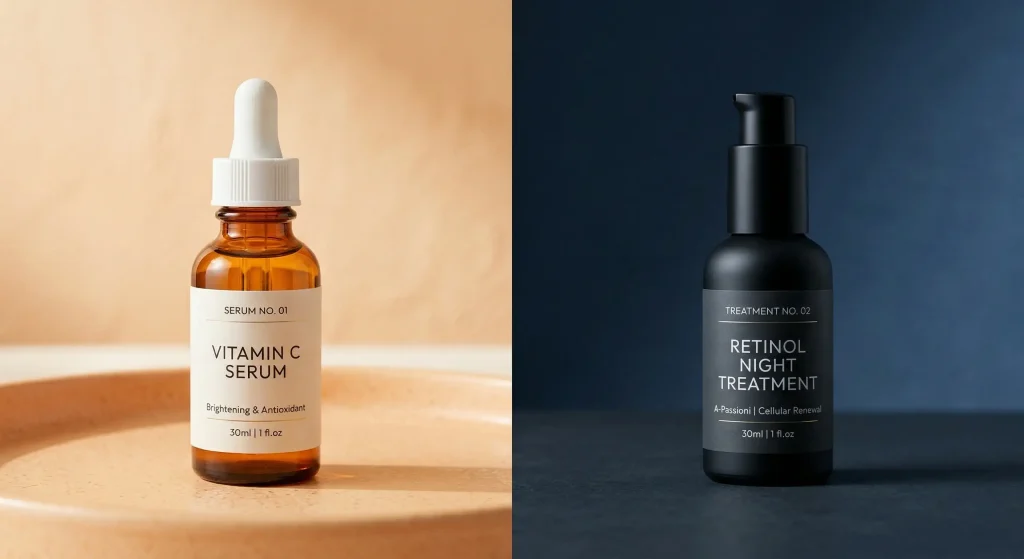
Here is the short answer, before the chemistry: yes, you can use both retinol and Vitamin C in the same skincare routine. What you almost certainly should not do is apply them directly on top of each other at the same time. The distinction matters, and understanding why requires a brief look at what each ingredient actually needs to function.
The Clinical Short Answer Retinol and Vitamin C are both highly effective and compatible within the same routine — but their conflicting pH requirements mean they should be used at different times of day, not simultaneously. The AM/PM split protocol is the dermatological consensus, and it works.
Why Do These Two Ingredients Clash? (The Science of pH)
The pH Problem
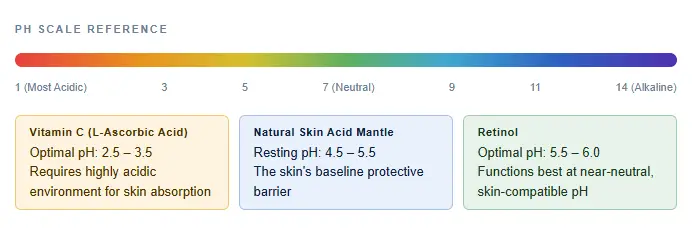
Every ingredient applied to skin operates within a specific pH window — the range of acidity or alkalinity at which it can actually do its job. Skin itself has a naturally acidic pH level of around 4.5 to 5.5, a property known as the “acid mantle,” which supports the barrier and keeps microbiome balance in check. The problem arises because retinol and Vitamin C require very different pH environments to be effective — and those environments are almost mutually exclusive.
Vitamin C and Its Strict Requirements
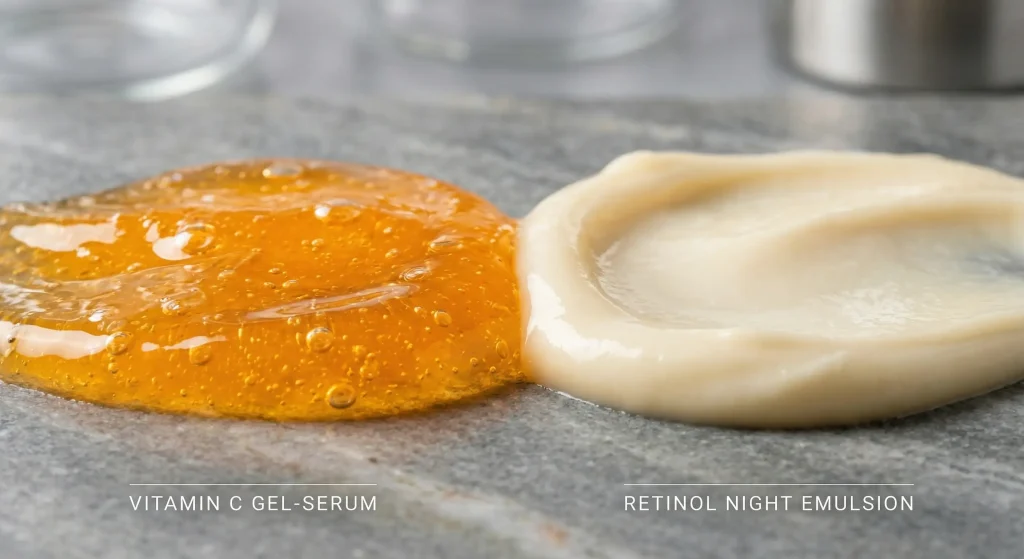
Pure Vitamin C — known in formulations as L-ascorbic acid — is inherently unstable. It oxidises rapidly when exposed to light, air, and alkaline conditions, which is why it’s almost always formulated at a very low pH, typically between 2.5 and 3.5. At this level of acidity, it remains stable long enough to penetrate the outer layers of the stratum corneum and reach the cells where it acts as an antioxidant and collagen co-factor. Raise the pH above roughly 4.0, and its bioavailability — the amount your skin can actually use — drops significantly.
Retinol and the Opposite Problem
Retinol, a derivative of Vitamin A, operates within a much more moderate pH range. Formulations are typically stabilised between pH 5.5 and 6.0 to balance efficacy with tolerability. More relevant here: retinol is vulnerable to degradation under highly acidic conditions, and applying it directly after an acidic Vitamin C product can destabilise the retinol molecule before it even begins working. The acidic residue from the Vitamin C product doesn’t fully dissipate for a significant period, meaning the pH environment on the skin’s surface remains inhospitable to retinol function for longer than most people assume.
The Irritation Risk Compounds
Beyond the efficacy problem, there is a direct physiological cost to layering these two actives at the same time. Vitamin C at low pH is already an irritant for many skin types. Retinol — particularly for those not yet adapted to it — causes its own inflammatory response as it accelerates cellular turnover. Applying both simultaneously doesn’t just reduce their effectiveness; it creates a compounding irritation load on the skin barrier that can trigger significant erythema, sensitivity, and barrier disruption even in people who tolerate each ingredient perfectly well in isolation.
How to Use Both Safely: The Golden AM/PM Rule
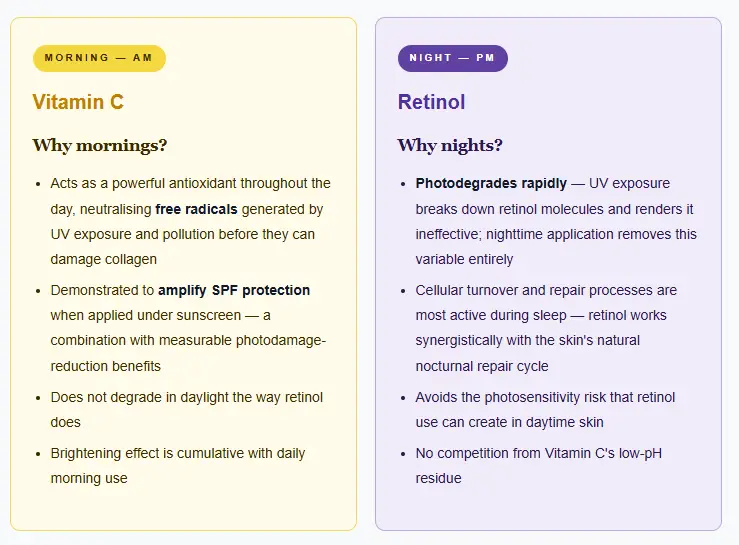
The practical solution to the pH conflict is also the most elegant one: separate the two ingredients by time of day. This protocol has broad agreement across dermatological literature and clinical practice, and it carries an added benefit — it places each ingredient in the environment where it is most biologically useful, not just chemically stable.
The Complete Recommended Routine Framework
Morning sequence: Gentle cleanser → Vitamin C serum (wait two minutes) → moisturiser → broad-spectrum SPF 30 or higher.
Evening sequence: Gentle cleanser → optional hydrating toner → retinol (wait five minutes for full absorption) → moisturiser containing ceramides or peptides to buffer the retinol and support barrier repair overnight.
A note on beginners: if you are new to either ingredient, introduce them separately before running both simultaneously. Start Vitamin C alone for two weeks, confirm your skin tolerates it, then introduce retinol on alternate nights. Rushing the process is the single most common cause of barrier damage in people who follow otherwise sound protocols.
What Happens If You Damage Your Skin Barrier?
Even with a careful protocol, barrier disruption happens — particularly if you start both ingredients at the same time, increase frequency too quickly, or use high-potency formulations without building tolerance. Recognising the symptoms early matters, because continuing to apply actives onto a compromised barrier makes the situation significantly worse.
| Symptom | Clinical Term | What It Indicates | Severity |
|---|---|---|---|
| Persistent facial redness that doesn’t resolve | Erythema | Inflammatory response in the epidermis | Moderate |
| Stinging or burning when applying basic moisturiser | Barrier disruption | Compromised stratum corneum — normally inert products now penetrating too deeply | High — stop actives immediately |
| Flaking and tightness not caused by dryness | Desquamation | Accelerated shedding from over-exfoliation or retinol excess | Moderate to High |
| New sensitivity to products previously well tolerated | Sensitisation | Impaired barrier allowing irritant penetration | Moderate |
| Breakouts in areas not previously acne-prone | Barrier-related congestion | Microbiome disruption following pH destabilisation | Moderate |
CLINICAL WARNING
If you experience stinging from a plain, fragrance-free moisturiser — a product that should cause no reaction on intact skin — your skin barrier is clinically compromised. This is the clearest possible signal to stop all active ingredients immediately. Continuing to apply retinol or Vitamin C onto a damaged barrier prolongs recovery and risks sensitising the skin to ingredients it would otherwise tolerate well.
The Barrier Recovery Protocol
- Stop all actives completely — that means retinol, Vitamin C, AHAs, BHAs, benzoyl peroxide, and any other exfoliating or functional ingredient. No exceptions.
- Switch to a minimal two-step routine: a gentle, low-pH cleanser (look for “gentle” or “hydrating” on the label, not foaming or clarifying) and a simple, fragrance-free moisturiser.
- Prioritise barrier-repair ingredients: ceramides (particularly ceramide NP, AP, and EOP), hyaluronic acid to draw moisture back to the surface, and niacinamide at low concentrations (2–5%) to reduce inflammation and support lipid production.
- Allow a minimum of two weeks of this stripped-back routine before considering reintroducing any actives. For moderate to severe disruption, four weeks is more appropriate.
- Reintroduce one ingredient at a time, starting at the lowest available concentration and the lowest possible frequency. If symptoms return, extend the recovery phase before trying again.
The Bottom Line
Retinol and Vitamin C are not enemies. Used correctly, they are complementary tools that address different aspects of skin ageing through distinct biological mechanisms — Vitamin C working at the surface during the day to block oxidative damage before it accumulates, retinol working at the cellular level overnight to reverse damage that has already occurred.
AMVitamin C serum → moisturiser → SPF. Every morning, without exception if sun exposure is expected.
PMRetinol → barrier-supportive moisturiser. Start 2–3 nights per week, increase only after full tolerance is established.
The most consistent finding across dermatological literature on topical actives is this: it is far more effective to use a moderate protocol consistently over months than an aggressive one for two weeks before your skin forces you to stop. The AM/PM split is not a compromise. It is the protocol that lets both ingredients do exactly what they are designed to do.
References & Further Reading
- The Roles of Vitamin C in Skin Health (PubMed Central, National Institutes of Health) — Pullar, J.M., Carr, A.C., Vissers, M.C.M. (2017)
- Retinoid or Retinol? Understanding the Anti-Aging Differences (American Academy of Dermatology Association)
- What Is Your Skin Barrier, and How Can You Protect It? (Healthline — Medically reviewed by certified dermatologists)