

They feel similar. They look similar. But they need completely different treatments — and confusing them is one of the most common ways people make their skin worse.
The Great Moisture Misunderstanding
Your skin feels tight, so you layer on a rich oil. It helps for twenty minutes. Then the tightness comes back. Or maybe the opposite: your skin is visibly flaky and rough, yet somehow you’re still breaking out along your jawline. You buy a heavier moisturiser. Nothing improves. You try a lighter one. Also nothing.
This is what happens when you treat a skin condition you haven’t correctly identified. And the misidentification is almost always the same one.
Dry skin and dehydrated skin feel frustratingly similar. Both create tightness, discomfort, and a complexion that looks dull and tired. But they are fundamentally different problems caused by different deficiencies — and they require entirely different solutions. Using the wrong fix doesn’t just fail to help. It can actively make the other problem worse.
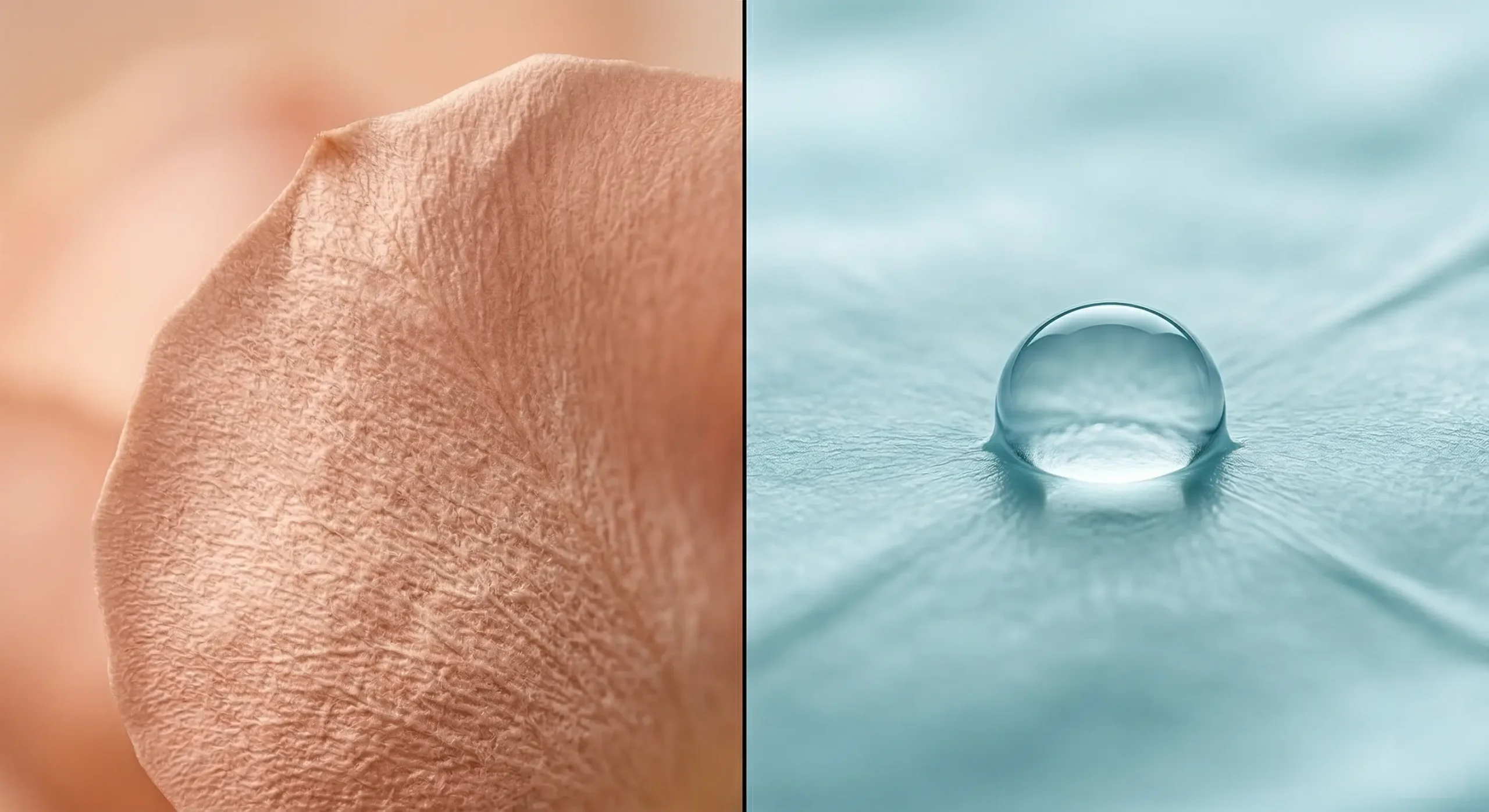
The distinction comes down to one clear principle: dry skin lacks oil. Dehydrated skin lacks water. That single difference changes everything about how you treat it.
Skin TypeDry SkinA genetic, permanent skin type characterised by the underproduction of Sebum — the skin’s natural oil. The lipid barrier is chronically depleted, not situationally disrupted. Lacks oil
Skin ConditionDehydrated SkinA temporary, treatable condition that can affect any skin type — including oily. The Stratum Corneum is depleted of water, usually from external or habitual causes. Lacks water
Dry Skin: The Genetic Baseline
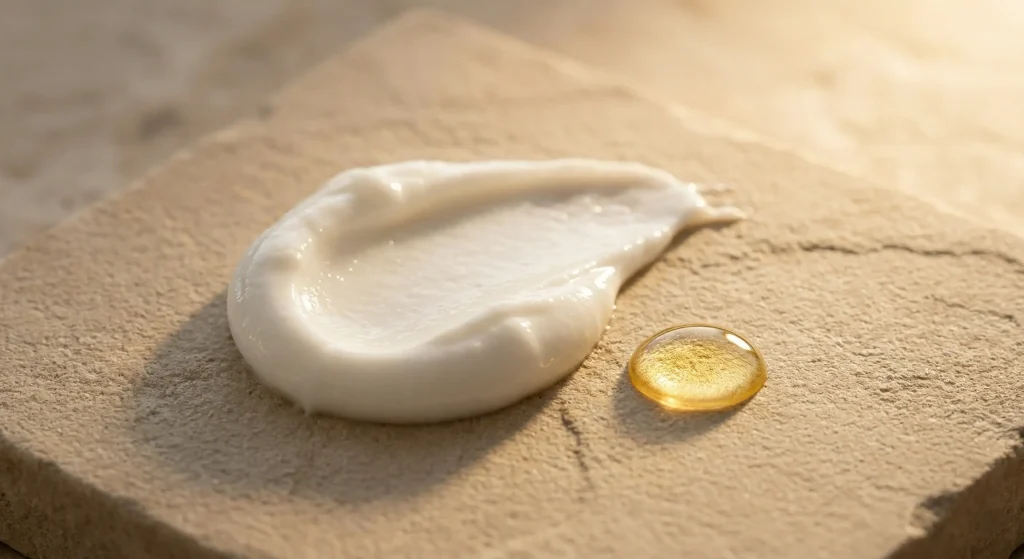
Dry skin is not something that happened to your skin. It is your skin type. The sebaceous glands — the structures responsible for producing Sebum, the skin’s own natural oil — are simply less active than in other skin types. They do not produce enough lipid output to adequately coat the surface of the Stratum Corneum, the outermost functional layer of your skin.
This is not a fixable deficiency in the way dehydration is. You cannot stimulate your sebaceous glands to permanently produce more sebum through topical products. What you can do is supplement externally what the skin fails to produce internally — and maintain that supplementation consistently.
Recognising Dry Skin
Classic Signs of Dry Skin (Skin Type)
Responds well to oils and rich balms — because the problem is lipid deficiency, adding lipids back externally provides genuine, lasting relief.
Nearly invisible pores — minimal sebum means minimal pore dilation. If you genuinely cannot see your pores even in good light, your skin is almost certainly dry rather than dehydrated.
Rough, flaky texture year-round — not just in winter, not just after a bad skincare week. Persistent and consistent roughness regardless of season or routine is a genetic baseline, not a situational crisis.
Rarely breaks out — dry skin lacks the sebum that feeds acne-causing bacteria. Breakouts that do occur are usually from product reactions rather than excess oil.
Feels tight even immediately after washing — the absence of a sebum film means nothing is sealing the surface, so water evaporates from the skin almost instantly after contact.
Dry skin does not fluctuate significantly with the seasons or with lifestyle. It may worsen in cold wind or low humidity because those conditions accelerate water loss from an already lipid-depleted surface. But it does not resolve in summer the way dehydration often does. It is the baseline.
Dehydrated Skin: The Temporary Crisis
Here is the thing that confuses everyone: dehydrated skin has nothing to do with how much water you drink. Hydration levels in the Stratum Corneum are regulated by the skin’s own lipid barrier — not by internal hydration status. And dehydration can happen to absolutely any skin type. Oily skin. Combination skin. Acne-prone skin. Even skin that has been carefully moisturised for years.
Dehydration is the depletion of water content within the upper layers of the skin — typically triggered by something external. Central heating strips atmospheric moisture from indoor air. High-pH cleansers dissolve the lipid mortar holding the barrier together, allowing water to escape. Over-exfoliation physically compromises the Stratum Corneum faster than it can repair itself. All of these increase Transepidermal Water Loss (TEWL) — the rate at which water evaporates through the skin’s surface — beyond what the barrier can control.
The Oily-But-Dry ParadoxDehydrated skin often looks shiny. When the skin senses water loss, it compensates by overproducing Sebum. The result is a surface that appears oily — and may even be breaking out — while simultaneously feeling tight, uncomfortable, and looking dull underneath the shine. This is one of the most misread presentations in skincare. Adding more oil to this skin makes the breakouts worse. The actual deficiency is water, not lipids.
Recognising Dehydrated Skin
Classic Signs of Dehydrated Skin (Skin Condition)
Fluctuates with environment and routine — worsens in air-conditioned or centrally heated rooms, after flying, or following a period of over-exfoliation. Unlike dry skin, it can genuinely improve when the cause is addressed.
Tight but shiny — the paradox described above. If your skin feels dry but looks oily, dehydration is almost certainly the explanation.
Makeup goes patchy and absorbs instantly — foundation that disappears into your skin within minutes, or concealer that clings to dry patches despite thorough moisturising beforehand, indicates low water content in the stratum corneum.
Fine lines become suddenly exaggerated — a crepey, crinkled texture that appears quickly and seems unrelated to age. Gently pressing your skin reveals fine lines that weren’t noticeable before. This is water loss, not collagen loss — it resolves when hydration is restored.
Dullness that doesn’t respond to exfoliation — dehydrated skin scatters light poorly and looks flat regardless of how smoothly exfoliated the surface is.
The At-Home Diagnostic: The Pinch Test

Before spending money on products, do this first. It takes ten seconds and tells you most of what you need to know.
On clean skin, with no products applied, gently pinch a small section of the skin on your cheek between two fingers. Hold for two seconds, then release. Watch what happens.
Result A — Lacks Water
Slow to snap back. Fine lines visible on the pinched area.
The skin wrinkles easily under light pressure and takes a noticeable moment to return to its resting state. This indicates low water content in the stratum corneum. Your priority is hydration — Humectants, not oils.
Result B — Lacks Oil
Snaps back but feels rough, tight, or flaky.
The skin returns to shape quickly — elasticity is intact — but the surface texture is rough or papery rather than smooth. This indicates lipid deficiency rather than water loss. Your priority is emollients and Occlusives to replace missing sebum.
And if both things happen — slow return and rough texture? You may be dealing with both conditions simultaneously. That is more common than most people realise, and the treatment protocol still applies: address water first, then seal with lipids.
The Treatment Protocol
Oil cannot fix dehydration. Drinking water cannot fix dry skin. The solutions are distinct — and the order in which you apply them matters.
For Dehydrated Skin
Treating Dehydration: The Flood
The goal is to draw water back into the upper layers of the skin and hold it there long enough for the barrier to stabilise. That requires Humectants — ingredients that attract water molecules either from the atmosphere or from deeper skin layers and bind them to the stratum corneum.
- Hyaluronic Acid is the most widely used humectant and genuinely effective, particularly at multiple molecular weights — different sizes penetrate to different depths, providing surface and sub-surface hydration simultaneously.
- Glycerin is inexpensive, highly effective, and frequently underestimated. It outperforms hyaluronic acid in some hydration studies and is particularly valuable in dry climates where atmospheric humidity is low.
- Snail Secretion Filtrate deserves specific attention here. Beyond its well-documented reparative properties, it functions as a lightweight, multi-functional hydration delivery system — its glycoprotein matrix binds water to the skin surface without the occlusive weight that can clog already oil-overcompensating dehydrated pores. For oily, acne-prone skin that is simultaneously dehydrated, this is one of the few hydrating ingredients that addresses the water deficit without aggravating breakouts.
Lightweight Hydration
For Snail Secretion Filtrate as a hydration-first approach to dehydrated or oily-dehydrated skin: COSRX Snail Mucin 96% Power Repairing Essence — Full Review
For Dry Skin
Treating Dryness: The Seal
Dry skin needs the mortar replaced. The lipid matrix is chronically underfilled, and no amount of water-attracting ingredient can compensate for a structural lipid deficit. What dry skin needs are the actual building blocks of that lipid matrix — and then something to hold them in place.
- A Ceramide-rich moisturiser is non-negotiable. Look specifically for ceramide NP, AP, and EOP alongside cholesterol and fatty acids — these are the three lipid classes that form the barrier’s structural matrix. A moisturiser containing only one of these will achieve partial results at best. The ratio matters.
- Emollients — ingredients like shea butter, squalane, and jojoba oil — soften and smooth the surface by filling the spaces between skin cells, mimicking the function of the sebum the skin is not producing.
- An Occlusive layer applied as a final step — petrolatum, Aquaphor, or a rich balm — slows Transepidermal Water Loss (TEWL) and gives the layers beneath it time to do their work. This is where simple, affordable options genuinely outperform expensive serums.
The Bottom Line
You can be both dry and dehydrated at the same time. In fact, dry skin types are often also dehydrated — because a chronically lipid-depleted barrier does a poor job of retaining water, making Transepidermal Water Loss (TEWL) chronically elevated. The conditions overlap, and both need to be addressed.
When in doubt about which one you are dealing with — or if the pinch test gives you an ambiguous result — start here:
Step 1 — WaterApply a Humectant first. Hyaluronic acid or glycerin on damp skin pulls water in. If your tightness resolves significantly with this step alone, dehydration was the primary issue.
Step 2 — SealFollow immediately with a ceramide-rich moisturiser and a light Occlusive. This addresses lipid deficiency and locks the water from step one where it belongs. If you needed this step to feel truly comfortable, dry skin is also in play.
Healthy skin is neither aggressive nor complicated. It is built on two foundations — adequate water and adequate lipids — and the products that work best are the ones that understand which of those two things is actually missing.